Search This Blog

Tuesday, July 9, 2013

Prevent Dehydration

No matter what time of year it is, we are always concerned about dehydration when working in the garden.  Children and adults need to be aware of how much water is leaving and entering their bodies.

Tips to Prevent Dehydration

  • Encourage adults and students to replace fluids at a rate that equals the loss of fluids.
  • Avoid exposure during high heat index days.
  • Work when temperatures are cooler in the day.
  • Wear light colored and loose fitting clothing.
  • Find shady areas to work in or rest in.
  • Take a lunch or snack break in an air conditioned room, even if it is for half an hour.

Make sure to prepare 5 gallon jugs of water, lemonade, and/or Gatorade filled before students and volunteers arrive in your school garden.  Encourage everyone to bring their own refillable bottles so that waste is reduced. Be prepared for those that don't bring their own bottles and bring twice as much as cups as needed.  Otherwise, ask volunteers or students to bring cases of water and Gatorade to share.  In hot weather, buy bags of ice to keep the drinks cold.
Stay in the shade.

Rotate teams to rest and stay hydrated in the shade.

Keep drinks in a shaded, central location for volunteers.

Monday, July 8, 2013

Beware of Dehydration

Believe it or not, but 75% of our body's weight is water.  Most of the water is found within the cells of the body.  The rest is found in blood, other body fluids, and around the cells. It is very important to drink plenty of water or sports drinks when working in the garden. If not careful, dehydration can occur.

Causes of Dehydration
Dehydration occurs when the amount of water leaving the body is greater than the amount being taken in.  We lose water when we breathe, urinate, and sweat.  Depending upon weather conditions, working in the garden can generate 16 ounces of sweat or more.

Signs of Dehydration
  • increased thirst 
  • dry mouth
  • muscle cramps
  • lightheadedness
  • decreased urine output
  • fainting
  • heart palpitations
  • urine becomes more yellow in color
  • nausea and vomiting
  • no tears
Severe Dehydration Symptoms
  • confusion and weakness
  • coma
  • organ failure
Treatment for Dehydration
  • Drink drinks that have electrolytes such as Gatorade.
  • Sip small amounts of fluid at a time.
  • Do not drink large amounts of water at one time.
  • Remove excess clothing.
  • Take the person to a shaded area in the garden, an air conditioned room inside a building, or near a fan.
  • Place wet towels around the person.
  • Spray skin surfaces with a spray bottle or mister.
  • Do not put ice packs or ice water on the person.  
Possible Complications
  • seizure
  • permanent brain damage
  • death
Seek medical treatment if the person is confused, has low blood pressure, is vomiting, has nausea, or has a fever.  Call 911 or take the person to the emergency room if near by. 

Thursday, July 4, 2013

Repurposing Flagstone for a Charming Pathway

When we have a big project like the pumpkin patch redesign in the agricultural area, we end up with left over materials.  In this case, we had small pieces of flagstone and a ton of pea gravel. 

Along our fence line from our mountain riparian into our agricultural area was a dirt path that students took.  It was formed over time because students like to go around the hills.  Since we already had pea gravel and flagstone pathways in the agricultural area, we decided to add a narrow pathway connecting the two areas where there was a lot of foot traffic.

First, clear the pathway of all the weeds and put a ring of block around the trees.  The path does not have to be level because it has a slight grade to climb into the hill areas of the mountain riparian area. Next, place the small pieces of flagstone into a mosaic design.  Don't over think the mosaic.  Just start placing pieces down and it will all come together once you add the pea gravel. Once the mosaic is completely laid out, dump piles of pea gravel over the flagstone.  The pea gravel will fall into the open spaces.  Use your hands, which have gloves on, to smooth out the pea gravel and wipe off excess gravel off of the flagstone.  

That's how we made our charming pathway connecting the mountain riparian area and the agricultural area.

Put block around the trees.

Randomly place odd pieces of flagstone on the path.

Dump piles of pea gravel onto the flagstone.                              

Pea gravel will fall in between the flagstone
once you push the gravel with your hand.
  Don't be too concerned about a few pieces
of pea gravel on the flagstone.


Always start at one end of the path and
               work your way down.
Enjoy a stroll along the charming pathway joining
our mountain riparian and agricultural areas.


Monday, July 1, 2013

Hay: A Benefit With a Drawback

Since our school garden is in the middle of the Mojave Desert and the temperature in the Las Vegas Valley is a record breaking 122 degrees, we decided to use hay as a mulch for our newly planted pumpkin seeds, herbs, and trees.
Hay bales are ready to be used to cool down new plants and retain moisture.
In the beginning of the growing season, hay encourages faster growth, prevents evaporation, conserves moisture, adds organic material over time as it decomposes, and reduces weed growth.

Hay is composed of cut wheat or barley stalks.  Straw is used for animal bedding, not feed.  Be sure to use Certified Noxious Weed Free bales of hay.

A drawback to using hay is that weed seeds are trapped in the bales of hay. Once hay gets watered, the weed seeds can sprout. Unfortunately, new types of weeds can be introduced into the garden.

Besides hay, we also use sawdust, bark chips, wood chips, leaves, and pine needles as mulch.  It depends on the time of year and what is available to us.

So for hot weather relief, help your newly sown seeds, trees, and flower beds with some kind of mulch.

An herb garden bed without any mulch will stress plants.

Fran and granddaughter, Savannah, are laying straw on pumpkin seeds that were just put into the soil.
Hay is placed on newly sown seeds so that birds
 don't eat them before they get a chance to grow.

Savannah is happy to protect her
pumpkin seeds from extreme heat and birds.


Saturday, June 29, 2013

Shovels: Class 3 Levers

Shovels: Class 3 Levers

A simple machine makes work easier.  It distributes the force needed to do work over a longer distance. The most widely used simple machine used at our garden is a shovel.  There are two parts to a shovel: the handle and the blade. We primarily use 3 different types of shovels.  
 
Digging shovel, Kids digging shovel, Drain spade, Square pointed shovel

Digging shovels have a curved scoop blade and are used for digging holes in soft soils and  transplanting trees and shrubs.

Square point shovels are used for scraping, digging hard packed soils, and trenching.

Drain spades are very narrow with slightly curved sides. They are used for clearing trenches, transplanting small shrubs, and adding flowers to an established bed.

Shovels are Class 3 levers because the fulcrum is at one end, and the effort is applied between the fulcrum and the load.  Other examples of class 3 levers are brooms, hoes, and baseball bats.

Class 2 levers have the fulcrum at one end of a lever arm and the load is between the fulcrum and the effort.  Examples of class 2 levers are wheelbarrows, bottle openers, and doors.  

Class 1 levers have the fulcrum located somewhere between the effort and the load.  Examples of class 1 levers are claw hammers, pliers, and scissors.

A great mnemonic device to remember levers is fre123:
  • Fulcrum in in the middle for Class 1 levers
  • Resistance is in the middle Class 2 levers
  • Effort is in the middle for Class 3 levers

Safety is important in a school garden.  The safety rule that we use in our garden is that the blade should never be above the knee when carrying the shovel.  Head injuries can occur when students lift the blade over their shoulders. Children have difficulty balancing the shovel because it is heavy at one end. Another reason why we apply this rule is that students will use the shovel as a baseball bat and swing it or as a sword and tap other shovels in the air, which could lead to injuries.

Saturday, June 22, 2013

Day 3 Pumpkin Patch Project

On Saturday June 22, the volunteers from Junior League of Las Vegas, Project Dinner Table and Los Vaqueros, returned for one more round to finish the pathways around the planter beds. The planters were filled with topsoil from last weekend.  Now it was time to finish the pathways.

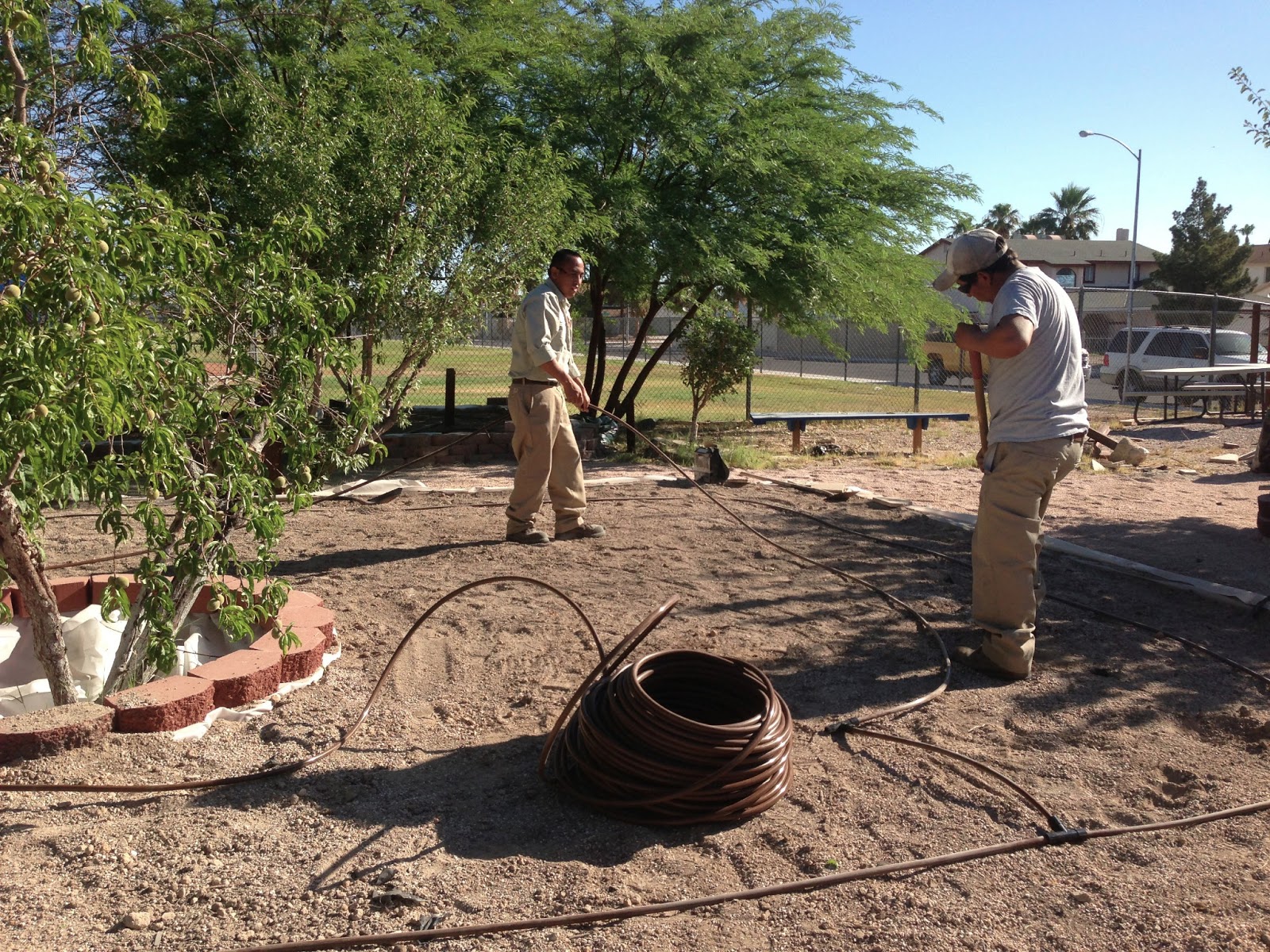
Flagstone was piled at the edge of the agricultural area.  First, volunteers had to smooth out the pathways with rakes.  Was it fog?  No, just dust from raking out the pathways.  Next, volunteers had to wheelbarrow in tons of pea gravel.  The volunteers were pros at this because of all the work they accomplished last week wheelbarrowing tons of topsoil for the planters. Finally, volunteers designed the pathways by laying out the 5 pallets of flagstone and the irrigation lines were put in.

Mr. Lopez, a fourth grade teacher from Gene Ward Elementary, worked side by side with his wife and daughter to make our pumpkin patch a success. Another father and son duo, Justin and Ed, from Los Vaqueros, worked from 5 am to 4 pm two weekends in a row.  This is what our garden is all about.  Families of all ages coming together to promote a healthy lifestyle and sustainable living.

flagstone for the pathways

Fog? Mist? Dry Ice? No, just dust from raking


irrigation
Volunteers: Los Vaqueros, Project Dinner Table, Junior League of Las Vegas

Miko is laying out a design of flagstone.

wheelbarrows waiting for pea gravel

Lily, our youngest volunteer, is entering 2nd grade

Mr. and Mrs. Lopez working together.  Mr. Lopez is a 4th grade teacher at Gene Ward.

straightening out the path for the pea gravel


Sunday, June 16, 2013

Day 2 Pumpkin Patch Project

Those dedicated Volunteers from Junior League of Las Vegas, Project Dinner Table, and Los Vaqueros came back on a Sunday at 6 am.  That's right-- on a Sunday and at 6 am-- for another work day to prepare Gene Ward's Pumpkin Patch.

Even though we had over 60 volunteers on June 15 and worked round the clock, there was more pea gravel and topsoil to add to the planters.  So it was time once again to shovel, transport, and rake, in the 110 degree hot, summer sun. 
Footprints in the pea gravel

Fran, teacher from Gene Ward Elementary, is relieved that the wheelbarrowing was done for the day.
Michelle from Junior League of Las Vegas

Gina from Project Dinner Table

Justin from Los Vaqueros